
Joan of Arc, or Jeanne d’Arc in French, was born in France in 1412 and died in 1431, burned at the stake as a heretic. Her crime? Listening to voices which she claimed were from heaven, and successfully fulfilling what they asked her to do – drive the English out of France and have the Dauphin crowned as King of France.
She was only 19 when she died, but her life has had great impact, and not just on the people of her country who were liberated. Although she died condemned as a heretic, she was finally canonized as a saint in 1920. Her Feast Day is May 30th, chosen because it was the day she was burned at the stake. Today she continues to be honored as an example of courage, piety, and patriotism.
Her Story
She was born in 1412 in the village of Domremy in the province of Lorraine in France. Her name is a matter of some confusion. Her surviving signatures are all spelled “Jehanne,” without any family name. “Jeanne” became the accepted French version. Clearly “Joan” is the English approximation.
She did not come from a place called “Arc,” so the “d’Arc” likely is an approximation of her father’s name. She often referred to herself as la Pucelle, “the Maiden,” and was known as “the Maid of Orleans” or “the Maid of Lorraine.” Her native village was renamed Domremy-la-Pucelle in her honor.
Her family were poor peasants. Jeanne tended the animals, and had little education. The 100 Years War was in full swing and much of France was under English control. The French monarchy was in a bad state. At age 14, Charles VII had assumed the title of “Dauphin” as heir to the throne of his insane father.
She Hears Voices

Jeanne first heard voices around 1424. She reported that the archangel Michael, Saint Catherine, and Saint Margaret told her to drive the English out of France. She was also instructed to bring the Dauphin to Rheims to be crowned King of France. Jeanne was convinced that these voices and visions were from God.
Initial Success
At first things went well. Jeanne gained an audience with the Dauphin, and convinced him to put her in charge of an army. She rode to victory relieving the siege of Orleans and swept on to free Reims.
At this point she was quite the heroine of the people. She was seen as fulfilling prophecies about a “Maiden” who would free France.
The Dauphin was crowned as King Charles VII in Reims Cathedral.

Accused of Heresy
However, things were not so simple and soon problems arose. Political issues threatened her position. A young woman riding around leading an army and doing better than veteran military leaders could not be popular for long!
And, despite her feminine appearance in some artwork, Jeanne had her hair cut short and wore a man’s clothes. This also led to criticism.
Unfortunately, during one of her campaigns, Jeanne was captured by the Burgundians who gave her to the English. If Charles VII had been a really good guy he could have rescued her. But, he didn’t.
So, Jeanne was at the mercy of the political machinations. The Church was quickly involved – well, she did say she heard voices of angels and saints giving her messages from God! Naturally, a heresy trial was initiated.
It seems to make sense, except that the trial was politically motivated and Bishop Cauchon had no legal jurisdiction. Small wonder they succeeded in convicting her of heresy despite her brilliant and pious answers. It seems they tricked her into signing a confession (she was illiterate) and agreeing to wear women’s clothing, and then leaving her no choice but to wear her soldier’s outfit again, either to protect herself against rape or because the dress was taken from her.
Burned at the Stake
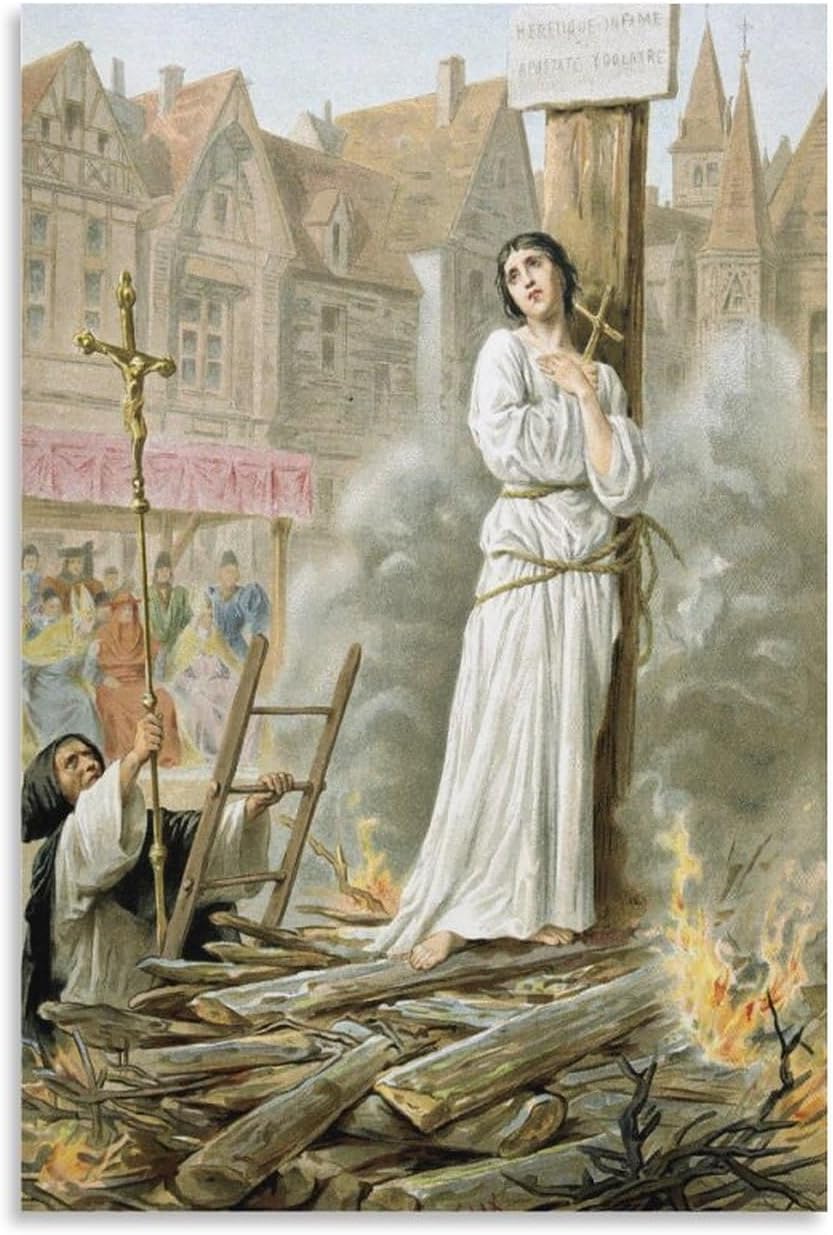
Convicted of heresy, the punishment for Jeanne d’Arc was death by burning at the stake.
It is said that she asked for a cross to be held high so that she could fix her eyes on it when they lit the wood under her.
It is also said that she cried out to Jesus in a clear voice as the flames rose.
She was only 19.
Canonized as a Saint
For five hundred years since her death people have sought to portray Jeanne d’Arc in every way imaginable. Some have said she was possessed by demons, defending the conviction of heresy. Many have suggested she was a puppet in the hands of the political leaders. But for the people, she has been an adored heroine, a martyr, and finally a saint.
Even when tortured and condemned to death by burning at the stake, she maintained her faith that she was guided by voices from God. Her beatification finally came in 1909; her canonization as a saint in 1920.
Why Does She Inspire Me?

A French heroine who united France driving out the English, and a Catholic saint – that really doesn’t sound much like me!
OK, well maybe because I was born and raised in Scotland I sympathize with driving out the English. And then she certainly had a lot of trouble with the Catholic Church, and at lot of the Protestants in my community had a pretty bad opinion of the Catholic Church. So she did have some things that I could relate to; being burned at the stake not so much though!
But still, why would this 15th century young French woman inspire me? Well, there’s a few reasons.
- She was absolutely convinced that she had been given a mission by God
- Most people don’t get missions from God! Sometimes we get inspired by good ideas, but we don’t usually experience voices or visions of angels and saints. And those that do are called crazy! But Jeanne d’Arc was very clear in her mind that she had been visited by messengers from God, and that the messages they gave her were vital to her country, and that God was with her in carrying out these directions. When I was young I had a lot of difficulty believing in God and religion, but I thought to have such an experience and to know absolutely that God was real and He had given you clear direction about what to do would be so amazing.
- She led an army on horseback to victory
- Well, when I was young I thought riding into battle carrying a sword up high would be so exciting! Fighting for what you believe in is an inspiring thing. And she didn’t just fight, she was victorious!
- She was just a teenage girl when she did all this
- Jeanne d’Arc wasn’t a seasoned soldier, she wasn’t a soldier at all. She was just a young girl when she was given her mission. She persuaded the Dauphin to give her an army, and led that army to victory when she was just a teenager!
How Do I See Her Today?
I’m no longer a teenage girl excited to ride off into battle waving a sword, a banner, or anything else! Perhaps it’s just that I’m older (and hopefully wiser) but perhaps it’s also that times have changed. Today, I see the solution to problems as less amenable to physical confrontation and more in need of solutions based on mutual respect, a desire for harmony, and an understanding that we are all God’s children.
Joan of Arc was inspired by God to lead the French army against the English. I have no doubt of that. She was very brave, and smart too. She persuaded the Dauphin to let her lead the army, she rallied the soldiers, and she led them to victory. Good going for anyone, let alone a young teenage girl!
She was famously captured, tried, tortured, and eventually burned at the stake. Quite a sacrifice for doing God’s will. But, more than all that physical pain, she had to abandon her family, her life, and any hope of marrying and having her own children. To me, now, I understand that that was a very great sacrifice.
Being canonized as a saint is good. And no doubt it’s a good thing for the Church to have reversed its judgement on her as a heretic, and to have given her the highest status of sainthood. But for Jeanne herself, does she spend eternity riding that horse into battle with her sword held high? Or worse, tied to a stake with the flames approaching? I hope not. I hope and pray that she was taken by her angels and saints and Jesus, to whom she cried out at the end, to a place in God’s kingdom where there is no more of that kind of pain.
 Jennifer P. Tanabe